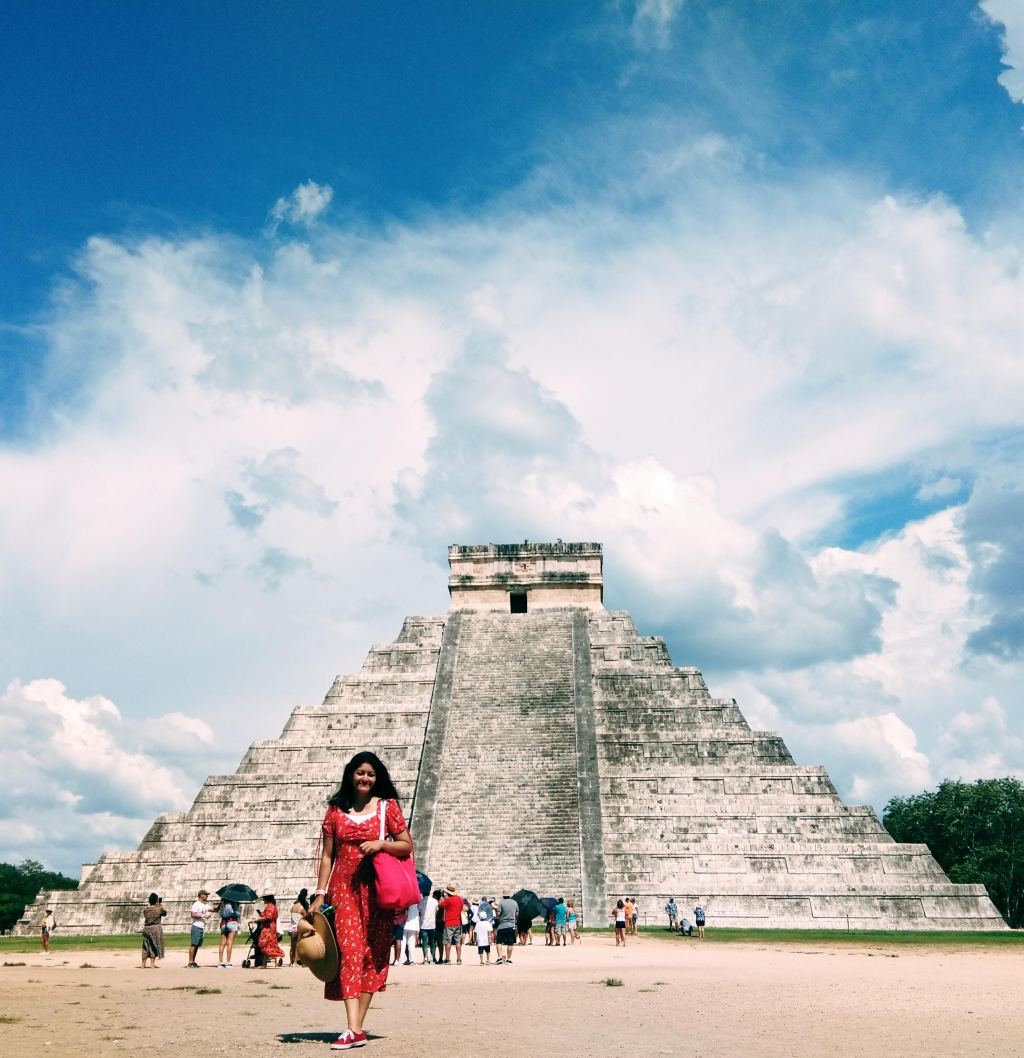
When visiting Mexico’s most famous temple the Temple of Kukulkan or Es Castillo at archaeological site Chichen Itza in 2019, I found a unique sound effect: clapping that made an echo like “tequila” when said out loud.
Then I learned the acoustic phenomenon where a single handclap produces an echo that astonishingly mimics the chirping sound of a quetzal bird belongs to The Temple of Kukulkan (El Castillo in Spanish or The Castle in English) at Chichen Itza. It was a deliberate acoustic marvel due to the pyramid’s precisely engineered steps acting like a diffraction grating, scattering sound waves into a tonal, bird-like chirp. This effect showcases the Maya’s advanced understanding of acoustics, geometry, and astronomy, integrating science, nature, and spirituality into their monumental architecture.
Temple of Kukulkan (El Castillo) at Chichen Itza is a stunning Mayan pyramid on the Yucatán Peninsula, famous for its astronomical alignments and serpent shadows during equinoxes. It has Equinox Phenomenon that during the spring and autumn equinoxes, sunlight casts triangular shadows on the northwest balustrade, creating the illusion of a serpent descending to meet the large carved snake heads at the base.
It is recognized as a New Wonder of the World, alongside other major sites like Teotihuachan’s Sun or Moon Pyramids, Tulum’s cliffside ruins and the unique Pyramid of the Magician at Uxmal, showcasing pre-Columbian architectures.
Built during the Pre-Columbian Maya civilization, between the 9th and 12th centuries CE, Chichen Itza has iconic step pyramid dedicated to the feathered serpent god Kukulkan, famous for its 365 steps (days of the year) and the serpent shadow phenomenon during the equinoxes. With a height of 30 meters, the temple has 91 steps on each of its four sides, totalling 365 steps (including the top platform), representing the days of the solar year.
In this present day, climbing the Temple of Kukulkan (El Castillo) is prohibited for visitor. We admire the architectural design and imagine how it looked like in the past, which has led to the present day.
 VelvetPage
Leave a comment